Since the art of telling stories is so essential for the articulation of
almost anything that is communicated, I thought I'd bring forward the continued inspiration for
new creative inventions that I get from the field of screenwriting. What
fascinates me about screenwriting is how it is the art of selecting what
is relevant to a story that "drives" the plot line forward - and of
course, what is left out as extraneous. For this reason, I'm always
curious to look at movies that are inspired by much longer and more
detailed books to bring forward this selection process, scene by scene.
One point that's not obviously revealed by merely watching movies is how
movie viewers have been educated over the years to figure out what is
happening in a story. Viewers are shown what has been determined by
producers to be relevant to the story in the scene action of the actors,
set and events. Of course this also includes indications of time
frames, foreshadowing of later events, suspense, drama, character
building, etc. Movie watchers are, to a great extent, completely unaware
of how much work they are doing to construct the plot, events and
characters as a story unfolds - and good storytelling never disturbs the
illusion of how a viewer must continue to be tracking these elements to
make sense of the illusion that is being created as an experience.
But how to put an ability to observe and analyze into becoming a new
invention? Comparing to reveal differences is my favorite means. Then
the differences can be used as a model or form, plugging in the
different content from an unrelated area that then becomes related.
Recipes are an obvious example of this. You can take the form of a
casserole, for instance - which is some sort of grain or starch in a
container that is baked, containing some sort of vegetable or meat and a
type of topping. Now you can take a genre of food, such as Lasagna
which is a baked dish - and switch the contents to another country's
food style - and you can make a Mexican food casserole instead of an
Italian one and have an original combination that wasn't obviously
apparent.
To apply this idea to music and screenwriting, there's a fascinating
parallel that imagines a piece of music as if it were a story. This
suggested to me how musicians could be playing roles in carrying out
what this story will become using their ability to improvise. If you'd
like to see the result of this invention that was inspired by this
parallel thinking of marrying the genre of screenwriting to musical
performance, check out the unique advantages of playing with the
arrangement and instrumentation of a musical piece as if it were a
story.
http://www.franis.org/out4improv/
Any invention takes a bit of investment to wrap your mind around, and
this one is no different. It's unpredictable what happens when you take
one genre and use it to inspire unique characteristics in another arena.
It often creates a synergy type combination, that is often useful for
more functions than could be originally expected. Using and playing with
a unique combination of genres will make these characteristics
apparent. Projects need to be "born" and brought to maturity by figuring
out what they are good for. Any baby is lots of trouble and not really
good for much of anything until it grows up into a person who can do
stuff - ideas are similar.
In this case, what started out as a convenient way to combine the
differing abilities and involvement level of a large group of performers
turned out to have other uses. As I used this newly invented system to
describe existing characteristics of musical styles that already existed
to see if it was relevant to them, I realized it could be used as a way
to invent a completely new musical style that could be infinitely
varied. It can also be used for one person to compose arrangements of a
performance piece...as a way for a music teacher to have all of their
students to improvise together, as a way to discuss musical arrangement
in general...how to give form to generalized "jamming" among musicians
who do not know each others songs. Possibly it could be crafted into a
composer's game with some programming - but I would think that the
experience of making music together with other people would be it's most
interesting and fun application. Of course, that means you would need a
"troupe" of people who played music on instruments or performed and
were interested in playing together with each other, which may be a
unique situation to find in this day of virtual reality.
For instance, a business application of such descriptive function in
common with the A-Game I invented is apparent in the "music genome" of
Pandora.com. Musicians working with Pandora listen to music and describe
the characteristics of common factors such as instrumentation, style,
use of harmony and rhythm and these descriptions are correlated to other
"similar" songs. These commonalities are now organized into a database,
so now any user of the site can specify a type of music they like and a
whole radio station is generated from these descriptions, containing
songs that the user would not normally become exposed to knowing about.
I'd love to know how you think the field of screenwriting could be applied to your favorite project.
Showing posts with label tools. Show all posts
Showing posts with label tools. Show all posts
Friday, March 16, 2012

Monday, August 16, 2010
Scapegoats
Blame is an interesting activity that is worthy of study. When there is something wrong, it's very curious why people first have the urge to go looking for someone else who can be the reason for their problems.Have to admit, this same thought of being a victim often happens when I must look for something that I have misplaced. What really happened was that I found a "secure" spot for it in a remotely "safe" location. In an attempt to foil possible theft, I hid the item from myself! Nobody stole it from me. But this is what I begin to fear as I frantically look for it.
No wonder people look for scapegoats. Someone to blame is so convenient to have around.
Sophie Lhoste Are polite relationships draining your energy?
Read: http://bit.ly/co9kuH
Reading this article leaves me to wonder how those energy vampires feel about people who label them.
Beyond the judgmental conclusions of name-calling, what do loving people constructively do about this situation? Couldn't people who complain and label just learn more gracefully and tactfully to ask for what they need or want as a questionable point continues to happen routinely? Why do we need to resort to name-calling to demonize others for allowing some room to adjust to each others evolving needs?
I'm asking these questions because I really want answers. A mark of true friendship is to be able to hear other points of view without imagining it is an attack. I don't intend to deliver my opinions veiled as questions. I want to let the spin cycle come to a close before we open the oven to see if the souffle fell. Divorce seems to be a rite of passage, rather than a last resort. People are too quick to come to a conclusion that writes off others. They could look for new ideas about how to deal with a new situation that is unfamiliar.
Let's think for a moment from the point of view of these people you want to blame for taking your energy.
What would they say they are doing to deal with how you are acting?
The first platitude that makes sense is "live and let live."
Can it be OK to say: "if you can't say something constructive, don't say anything"...?
What about the tolerance and compassion of, "OK, whatever floats your boat"!
Isn't it supportive to indicate," I'm gonna leave it up to you to call me when your available again."
Is it a requirement that those closest to us should ALWAYS read our minds so they can provide exactly the support we need in the moments they determine that we must have it?
Isn't that a bit self-involved to expect from the mere humans who happen to have already been loving us?
Why should every moment, every support, every activity be so much drama that we must come to a resolved conclusion about What It Is and arbitrarily determined we should cut off the relationships that we have decided must be "draining us"?
It's the empty spaces that get left up to us to provide content. Leave some dead air for a change and have it all be OK. Assume love. Those people who used to love you might want you to be happy, but are they could be innocently clueless about what you want them to do because you're not being all that articulate. Get a little more proactive and indicate what is appropriate and constructive. Just...take a nap or go for a walk; play with the pet or the kids. Nobody is sucking you dry, just stop expecting there is a trade or tacit agreement of exchange as you give.
Wednesday, February 04, 2009
Make Time: Sleep Less
 Sleep less and you'll have the time to be creative, make more money at a second job or whatever you want to do. But don't just deprive yourself of sleep - get smarter about it.
When I was going to Alexander Technique teacher training school and had to pay for it myself AND live an hour commute away, I came up with the brilliant idea of a split sleeping schedule. Went from nine hours a night sleep to a daily total of five hours with no ill effects. After around three weeks to get used to the schedule, it worked beautifully. I had no trouble keeping it up for over a year - so my experiment stood the test of time! Now whenever I want to stay up late for music or dancing, I can switch into that schedule without having to "get used to it."
I've become a "happy napper"! To my mind, the ability to nap is one of life's secrets.
The best schedule was a split sleeping time. Heard this hint from learning about a study with college students where the minimized sleeping schedule of 12 hours apart was the most common cycle tolerated by the most people. Decided to be sleeping 12 hours apart. For most people, how long to sleep two hours apart would be determined by the timing of their own sleep cycle. After experimenting with how awake I felt after sleeping certain amounts of time, I observed that the best sleep cycle for me turned out to be 1 1/2 hour plus a little time to get deep into falling asleep. So two hours was a good minimum cycle for me that gave me much more sustaining energy than a random "nap."
Rather deliberately because it worked into my schedule, I chose the actual times from 4am-7:30 twelve hours apart, which gave me two cycles each. It turned out that I could get by with the afternoon cycle being only two hours; from 4pm-6pm. It worked elegantly in practice. I would go to sleep at the end of the day and wake up, having all night to be awake...then go to sleep at the end of the night and be awake to have all day.
The only thing I missed is that I never got to see the sunset during the winter.
The trick to start the routine is to pick a time when you want to take a nap anyway. Turn off the phone, lock the door, make the room dark if possible - and it also helps to go through your nightly "routine of going to bed" rather than just treating it as a nap.
With this schedule, you could have two jobs, have more time for the internet or for doing your creative projects, have time for yourself while the kids are sleeping, etc.
Warning: don't let friends who show up from out of town talk you into skipping your sleeping times. You can't "catch up" later once you establish these times. You'll have to sleep ten hours if you get knocked off your routine; or at least I did the two times this happened to me.
Monday, August 21, 2006
Percentage of the Whole
It has always bothered me that I have such a tricky time using English words to describe the relative percentages of how many different feelings I might have in my relationship to someone or something. When I say something using English, other people I'm talking with can't get past the connotation that what I am saying is the priority quality of what I mean, merely by the fact that I uttered it.
I don't know if that's the mannerism of talking I learned as a child, or what, but I notice its limitation in communication and I don't know what to do about it. What I really want to do is to say something, then say lots of somethings, and then assign a percentage to them independently that shows their relationship to how I feel about the whole thing I'm concerned with. I can't do that so easily with English. So thats' why I think English words are a lousy way to describe what I'm trying to make the language do. I want a way that I can articulate many opposing feelings and points of view, and then I want to assign their priority in relationship to how I am going to allow me to guide my decision-making, or create the effect I'm going to have on someone else to communicate, teach or entertain. I want to have an emotional truth, a factual truth, a complete fantasy and a bottom line truth - and many more truths - all operating at once inside me...because this is how I experience my own perceptual self.
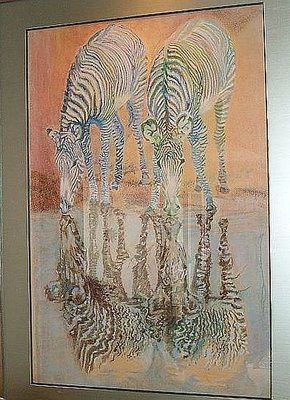
If I am communicating using music, or art, or other multi-media, etc. I can contain all the opposing points of view into a whole much easier. In words there are so many oppositions that are supposed to preclude and cancel out each other, that I am constantly frustrated when I try to communicate the relational importance of the content of what I'm saying. What my culture defines as opposite gets in my way.
I imagine that's why description is so much of our image of something and how it seems to us now. It strikes me also that's why science tries to limit experiments so their descriptive results actually "prove" something about this shared reality that we squirelley humans are perceiving and creating.
I don't know if that's the mannerism of talking I learned as a child, or what, but I notice its limitation in communication and I don't know what to do about it. What I really want to do is to say something, then say lots of somethings, and then assign a percentage to them independently that shows their relationship to how I feel about the whole thing I'm concerned with. I can't do that so easily with English. So thats' why I think English words are a lousy way to describe what I'm trying to make the language do. I want a way that I can articulate many opposing feelings and points of view, and then I want to assign their priority in relationship to how I am going to allow me to guide my decision-making, or create the effect I'm going to have on someone else to communicate, teach or entertain. I want to have an emotional truth, a factual truth, a complete fantasy and a bottom line truth - and many more truths - all operating at once inside me...because this is how I experience my own perceptual self.
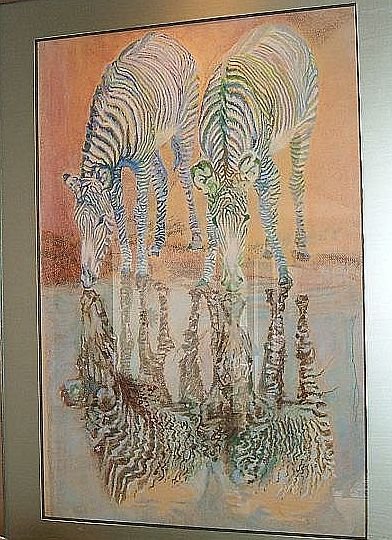
If I am communicating using music, or art, or other multi-media, etc. I can contain all the opposing points of view into a whole much easier. In words there are so many oppositions that are supposed to preclude and cancel out each other, that I am constantly frustrated when I try to communicate the relational importance of the content of what I'm saying. What my culture defines as opposite gets in my way.
I imagine that's why description is so much of our image of something and how it seems to us now. It strikes me also that's why science tries to limit experiments so their descriptive results actually "prove" something about this shared reality that we squirelley humans are perceiving and creating.
Subscribe to:
Posts (Atom)