Search This Blog

Thursday, June 22, 2006

Observing Without Interferring

"You were saying something about seeing what happens without doing anything - in fact, a lot of Alexander teachers mention this - but there is something about this that I really can't understand."

Your habits are in charge of keeping things the same. Lots of people can tell after something has changed - but only a few can sense change as it is happening - and describe what is happening as it is going on. Even more rare are the times you can witness the very first thing that starts the chain of events into action. - That's almost a transcendant challenge.

Most of the time, sort of like waking up in a lucid dream, you realize that here you are in the middle of the story, doing mysterious things for reasons you don't understand, instead of the beginning that you would like to be able to remember. The challenge is to find out what and how you did what you wanted to do, so you can go through a similar proces and maybe discover another amazing secret about yourself.

  • What happened that made an experience that was so different?
  • Can you wake up to witness yourself changing as it is happening?

It sounds esoteric, but it's not so hard, it's an unfamiliar sort of easy. Your habits make it hard. This challenge is helped by the fact that your habit that you're moving away from or prevent is so habitual and easy to repeat any time you want to. Really, you don't have to trace what is happening as it is happening any further back than just one tiny moment of awareness before what you have found out before. String those discoveries together, watch without caring so much - and poof! you'll notice the next surprise in what may turn out to be an important chain of events.

How to remember back the moment before? What did you do, just before? As far back in time as you can - Was it the sequence, was it your attention, which direction did you go, what was the quality of the motion, what did you hear, breathe, where did your attention go, when?

Sometimes it takes a long time to learn to do this. You'll wake up sooner and sooner. You'll remember more and more. One time, there you'll be at the source of the old choice you made when you put the habit in place. You might "remember" the reason why this particular habit; or suddenly be inside of an era when you trained the habit...or hear something your parent told you when you were so young. The memory may be the other direction, a memory of once being free of the habit before you thought you needed it. Then - think about what happened. Don't make a decision about it, or a conclusion. Record it. Be careful who you tell it to, because saying it sometimes leaves out important parts. Go back and get those parts you left out the first time you tried to describe what happened.

Wednesday, June 21, 2006

Asking Great Questions

As a topic in general, good questioning has many examples in every field. It pays to study the process of questioning as a separate subject, as if you were going to design an FAQ for your skill. Not only can it make you a better learner, but a better teacher.

If you are a teacher, you know there are multiple advantages about encouraging questioning from the start. Questions from a student show a teacher their student's range and style of thinking. Questions point in the direction of the answers. In fact, questions can imply a limitation of what kind of answers that are possible to find. Better questions open up a rich field of personal discovery.

How do you ask a really good question?

As a student, you can ask any question to get started. Sometimes the first questions that come off the top of your head aren't the most appropriate, but everyone has to start somewhere. Most teachers understand this.

As a learner, to ask a really juicy question, you first have to listen carefully to learn any "lingo" about the topic. So the best questions to start with are often about the specialized use of terms being used.

The other skill that's good to develop as a questioner is being able to tell the teacher the best way that you learn by indicating acknowledgment you are following them. It's useful for the teacher to know when the student is on "over-load, please change tactics now" or "I've got it, go on" to the teacher.

Some learners believe some kinds of questions might be insulting or too challenging for the teacher.

At first, even in a private lesson, most students seem to want a teacher to "lecture" them. They want to let the master talk. The teacher saying something to preface or frame a lesson might be appropriate in some cases. But what if the teacher doesn't really want to go on about the topic; what if they want their student's involvement from the very beginning?

Some teachers address this desire by doing the asking themselves, and then answering their own questions. They hope that the students will get the idea of what kind of questions to ask and starting to ask questions themselves. However, students can misunderstand that questions posed by the teacher and then answered are merely rhetorical ones; that the teacher is asking these questions to show off their knowledge. The students may imagine that the teacher would never ask a question that they don't already know the answer to. What to do when the teacher finds that students resort to parroting or restating the teacher's questions with other motivations such as to gain approval?

How can a teacher encourage learners to get past their misconceptions that particular issues, communications or questions are somehow "forbidden" without losing ability of being able to direct the class? Part of being a teacher is the skill of pulling together the attention of the group. There are some assumptions that create problems with encouraging this activity in learners related to respecting the teacher; especially in a large class situation. What to do when students seem to believe that they are being encouraged to deliver certain questions that cross the line of impolitely questioning the ability of the teacher to teach?

It's very tricky to ask a question that will point in an entirely new direction. Questions can imply that there is one answer, rather than a multiplicity of answers. It's also easy to think that just because you have come up with an answer to a question - that this one answer is enough of an answer.

Fantastic and personally meaningful questions sometimes need quite a bit of personal experimentation to adequately explore their potential. Sometimes this kind of question can become a sort of "virtual question" that many actions of exploration are continually answering during the course of life.
  • How can you encourage your students to ask really good question of the teacher?
  • How can a teacher get around student's misconceptions about the nature of authority, for instance, without inviting disrespect? (We're talking about adult learners here.)

Instead of my lecturing, here's an account from many years ago about a teacher of mine who I considered to be a master. In this case, she was teaching Alexander Technique, but this relates to asking questions concerning any skill.


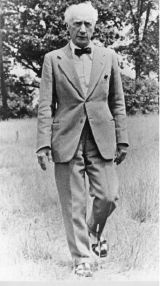
My teacher was in her late eighties here. She's almost five feet tall. Classes could be huge; sixty to eighty people in one room. The advantage was that the workshop lasted for weeks. The disadvantage was that people figured it was too early in the workshop to dare to risk anything in front of everyone else.

My teacher was too polite to be overt about what must have been some frustration beyond kidding the group, "What do I have to do to get some questions and thinking out of more of you people, do a jig?" Most often, laughter, but no daring questions. The humor did have some effect to loosen people up.

The experience of feeling a new perceptual assumption that Alexander Technique delivers is unsettling to many people. A master of an art can sometimes come across as frightening or magical. In this case, people were both attracted and intimidated. This little old lady could shake people's foundations; pull the carpet out from underneath their very sense of self. So the group treated her with "respect." For some people, this turned out to be a kid glove sort of unquestioning loyalty and agreement.

This little old lady named Marj Barstow hated that. She had a number of ways of dealing with it. One was to invite different people to get up in front of the class for a "private" lesson with her... with everyone else watching. While working with someone she would ask, "So you see that little difference? Can someone describe what they see?" She wouldn't go on until someone described it.

That's how she taught us to see very subtle indications of motion or a lack of movement. That also taught us to ask ourselves what these indications meant in each specific situation with each different person. It was also how she embarassed people, and then showed them the way out of the crippling emotions of stage fright, embarassment and being completely tongue-tied.

She might ask the group to move in slow motion to illustrate a crucially pivotal point that influenced that entire outcome of what someone was trying to do. Then we learned how to integrate the special points with the whole, normally speeded action again.

These examples of techniques to encourage questions are, (or should be) commonplace to any teacher. The one I'll tell you about next surprised me, because I regarded it as being positively sneaky.

My teacher took me aside and told me that she appreciated having me and a few other people in the class. She said that it was because we'd pipe up with questions that nobody else would dare ask. She then told me a story about how she didn't understand when another student accused her of putting them on the spot by singling them out, inviting their participation. This is what made me realize that she was asking my permission to deliberately put her "on the spot" by bringing up what may be forbidden as defined by the group of students. This little old lady had some unusual ideas in her field about how her skill should be taught. People seemed to be avoiding asking her specifically about what made her ways different. I decided that she wanted me to break the ice, so to speak, for the rest of the class.

Essentially, she gave me license to be planted as a sort of "sacrificial fool" in the forbidden questions department. People would stare at me with open mouths and shocked looks on their faces when I'd fire off these questions that nobody else would dare say.

It pleased the teacher and myself immensely - I felt as if we were conspiring together. After those kind of questions were in the air, class would get much more interesting. Other students would then started to ask the questions that were very important to them personally.

So if you are a teacher, don't be above encouraging one of your students to act as a 'secret plant' in the classroom! Certainly - if you've got any comments or questions to ask me - please speak up now!
Monday, June 19, 2006

Escaping from Hayfever

I'm actually heading to see the love of my life. Glad to be escaping Bolinas at a time when everything had to wait to bloom at once so late. Already wishing that I could stay longer.

My sweetie has a really nice place for me to stay on the Big Island of Hawaii so I can recover from the stress of hayfever for a little while. I wish that my landlords could figure out what I'm supposed to do to have a roommate so I could stay longer, because spring was so late this year.

The place I get to stay on the Big Island has a nice view of Kealakekua Bay; I just arrived; but already my favorite place to swim is Ho'okena Beach. The City of Refuge is a really nice place to burn some meat and dawdle in tide pools. Actually, the photo of the kitty on this page was a wild kitty who lives there and begs from the barbequers.

The day I first arrived I ran into an old friend on Ho'okena Beach who invited me to a really interesting music party just this weekend. At this party I got to see some incredible footage that showed this man who could blow bubbles the size of hula-hoops snorkling down to about thirty-five feet with spinner dolphins - almost 50 of them! Dolphins commonly come close to shore within the distance that I can swim; so I'm really looking forward to getting up my health to where I can swim with them myself.

I'm working on that by swimming every day enough to completely exhaust myself. It's a wonderful thing to do for one's body. It's amazing how bad one's health can get without exercise and without noticing it's happening.

You'll read some of my other animal stories next...and then maybe I'll get strong enough to having some new experiences with dolphins!

Tuesday, June 06, 2006

Getting That Feeling Back Again

"The way the self is rearranged from within. How would you describe the difference between feeling self rearrangement and imposing that arrangement to one's self?"

By asking the question that way - you've got bits of the answer. It's how go from one to the other that you want to learn to do in a new way.

How do you "get" something you know? Perhaps it's a kind of filing system that you use to go and "get" an experience again. That way of "getting" the experience only works if you know where and how the experience can happen again that will work. You'll find that if you've just had a new experience - your ways of retrieving a filed system of feeling won't work to retrieve that new experience.

That's why Alexander teachers will say - observe what happens as you go into action without giving yourself the order to "do something." It's as if you're going to doing something before you've gotten "ready," because "getting ready" is actually revving up the habit to fire off. I've written more about this before in a previous post called "magic words."

To see your thinking/actions in motion, it helps to practice leaving off imposing your idea of what you should be doing from what you're observing. In Alexander Technique, we have tricks - we like to trick our habits and confuse them, so they give up and stop coercing everything we do. To do that, you would tell yourself you're not going to "do it that old way." Instead, you tell yourself that you're just going to sneak by those old habits and do only the little parts of the action, bit by bit - In AT we call that the "means whereby."

As an example, instead of "I'm thirsty, I'm going to grab the glass and drink some water"... You could direct yourself to move your whole head... Follow with your whole body... Move your eyes to turn your head... Move your fingers off the table... Move your elbow behind your back... Move your shoulders wider... Move your body to follow your head.... Swivel your hand across the table... Cradle the glass with your fingers... Move your head and body... Decide how much the glass weighs... Let your elbow move as your arm moves... Reassure yourself that you're not going to drop the glass with your light touch of it... Raise the glass off the table... Feel how much the liquid weighs... Bring the edge of the glass to your lips...and now feel your thirst. Strange process, huh? Essentially, we're doing all that to completely bore our old habit into giving up.

After we do that enough, the habit becomes a little empty. The glass becomes lighter. The habit loses its urgent necessity and endless blathering justifications of how it's so essential. Meanwhile, we've trained a completely new way to drink water, or type words, or whatever we practiced without our habits in the way.

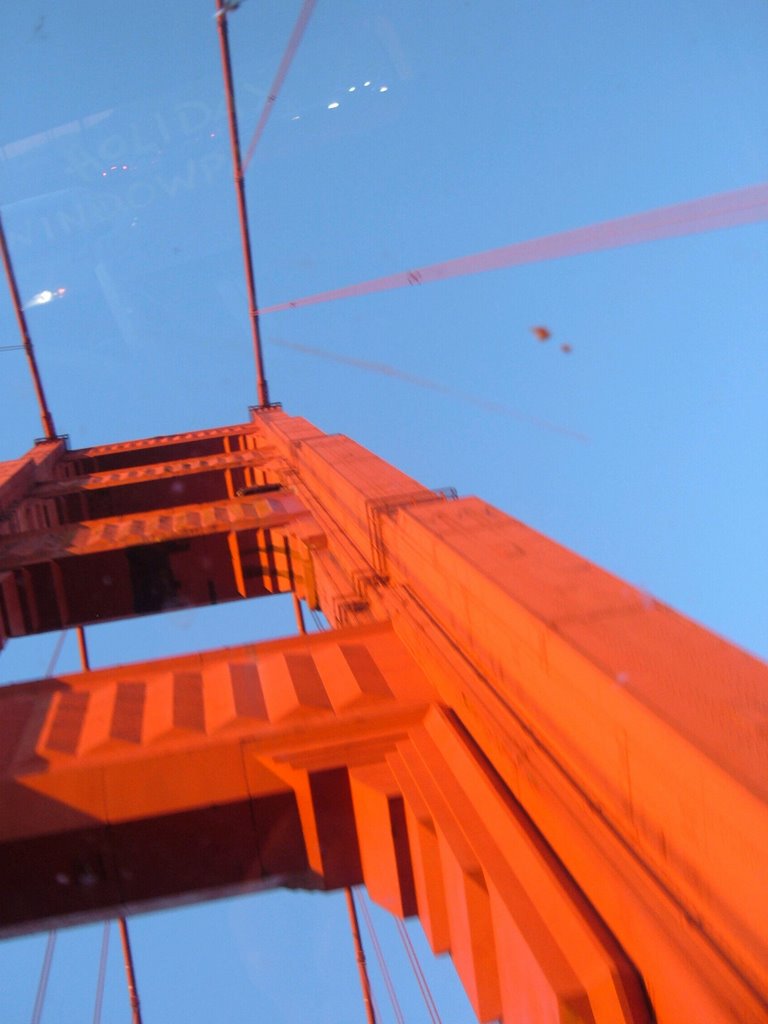
Golden Gate Bridge In Alexander Technique, we call that suspending your goals, or using a willingness to experiment. Recreating your feelings that happen after you're experimenting is a trap - because if you're going where you haven't been before, how can you use your habits to get you there again? You can't. Instead you're going to be using your strategic thinking, your observation and you're going to suspend doing what didn't work before. Just leave it out. Drop it. Give up. Admit you don't know. (You'll be happy about not knowing. It means you still have something fascinating yet to discover!)

Thursday, May 25, 2006

Catharsis, Refusal & Denial


I was thinking today about assumptions I've had about psychology.

I was really convinced in the value of uncovering what is hidden in yourself so it would not control your actions from the inside of you. Speaking or expressing internal struggles brought what was concerning to to the light of reason or at least
expression them brought them to awareness so you could recognize them when they came along. I came to actually welcome cartharsis, to relish it; I would even gleefully exaggerate the problem. I thought diving into what seemed to be the problem helped me unravel it and recognize it so that later I could avoid it's stranglehold.

However, I have learned that sometimes, catharsis takes you where you don't really need to go and is useless in "dealing with" problems. Sometimes the best solution is to refuse to go there. This refusal has nothing to do with denial, and everything to do with making a choice. Deciding to not participate, you can just leave what you do not want to do all behind you in the dust as you move forward into what you do want.

This must have been how people used to deal with psychological issues before psychology came along with the other model. I've learned that diving into what bothers you and exaggerate it, bring it up to the light where it can't have power
over you by being hidden doesn't work in certain situations. Such as ones where you were truly an innocent victim, or other horrible situations that are best forgotten.

There must be more than just these two ways of dealing with our "stuff." I'm open to hearing about them.

Tuesday, May 16, 2006

Anger

Thinking how anger seems to be a "pure" emotion - meaning it seems to act as a foundation to other emotions. I guess that isn't always true about anger, but I'm entertaining the hypothesis here.

The exception that comes to mind is anger that arises from wanting to avoid feeling another emotion that doesn't necessarily have to be fear, say grief, powerlessness, envy, etc. So in this case the anger would be triggered by something or someone, but the person does not say to themselves, "feeling angry is better than feeling this other emotion underneath the anger." I would guess it may be a better description to say, "I'm angry because of this trigger leads me to interpret my situation as needing anger as the necessary response."

Having witnessed that chain of thinking in myself, it led a conviction that there are always more possible responses available - and usually there are responses that are much more constructive than anger. But sometimes, anger is the best choice and not purely an "out of control" response.

I have also witnessed how a close friend formed a reactive chain of emotions, with anger on the tip of the iceberg. It took him some time to observe his anger; it happened in sequence with the closer feelings behind it, driving the anger. Certainly anger feels more powerful than to feel these "weaker" emotions, (such as sadness or vulnerability.) A person would probably have to feel safe to uncover these other emotions. So I'd agree that there can be some sort of fear mixed into anger, but not always.

Also, I can think of circumstances where anger is meant constructively. Anger can be displayed as a control issue or other form of a demand for respect or to have priority. It's constructive because the anger is used to draw boundaries for a trespasser.

What about the sort of anger that acts as a display to have a certain calculated effect on another person for an intended, justified reason? I'm thinking of the tactical displays that someone I knew has used quite liberally with the justification that he is doing it order to "transform" someone else or teach them. Isn't another example the anger that a parent displays with the calculated purpose to give a child some of the wrath of the world upon them, but not the full effect ?

Also, think of straight old manipulation, the motive of which can be of questionable or unknown priorities. Whether the manipulation is constructive or not is certainly a value judgment. The fury or intensity of anger makes the angry person feel powerful & unpredictable and has the effect of intimidating others; for instance the manipulative warning/threat of "you don't want to be my focus while I'm crazed by anger that I can't control."

I think anger is a positive emotional response when there are certain boundary issues that a person is convinced should be rigourously enforced. For instance, when a recalcitrant is trying to "get your goat" purposefully just to see how irritating they can be or what they can get out of you. From their point of view, they're merely investigating to find out you will react in a conciliatory way of benefit to them.

angry looking monkey

I'm thinking of other sorts of anger that can act like vigorous resolve. What about the anger directed at oneself for the purpose of goading yourself into action or admonishing oneself to be more mindful? For instance, the anger of someone who is quitting smoking; every time they want tobacco, they say "NO" with the emphasis of the anger directed to buck the addiction. I'd say in that case that anger is a positive response to the coersion of a situational nuisance.

What about regarding the emotion of anger as being purely a way of generating lots of energy and pointing it somewhere on purpose? Wouldn't that attitude take away the value judgment that anger is "good" or "bad"?

Really, any emotional feeling could be substituted for anger here. See how much information you can learn about yourself. Take away the value judgment about whether the emotion is good or bad.

Saturday, May 06, 2006

How I Make Sense of How People Talk

As I listen to someone speak or write, I'm first paying attention to how they put the building blocks of language together - what they associate, how they jump from one subject to the next, how they tag similarity and difference; where they go when they make these associative leaps.

I threatened to continue the conversation I started about how the structure of language dictates what you can say or think as you're using it.

I'm reminded of Whorf's work. In Hopi, there are only two forms of the verb - objective and subjective. Meaning, it's built-in to not tell a lie in Hopi; everything is presented as your point of view (POV) as if it is an intangible that you are referring to. You'd use the subjective when what you're talking about is not able to be seen by both people. In Hopi, it is the built-in structure that always says "it seems to me that..." This structure is in what you did yesterday or what you intend to do next. As you talk in Hopi, the past, the future, etc. is all brought to the present moment. The reason you're bringing it to the present is inherent in your motives for saying it. (Actually, there's alot of teasing that goes on in Hopi that speculates and assigns humourous "shameful" motives. )

In Hopi, instead of conjugating verbs, there is a huge category of adverbs that talk about direction, duration, qualities, sequences - it's these many, many adverbs that some say make Hopi regard the world from the POV of physicists and superb observers. To the Hopi, the world is made up of actions that are internal or witnessed; these relationships are described, not defined.

You can try, but you cannot really say "from my point of view" in English. It's always a qualification, a frame, an add-on uttered in an attempt to modify the rest of the what you say. It relies on the the other person to compensate for whatever you say that follows. So saying it implies that the other person has the ability and also does know how to add the frame in to modifiy the meaning of what follows.
flamingos

In fact many people cannot do this brain-work, because they have little practice at suspending. Suspension is what I'm asking someone to do when I'd qualifiy something that I say with the phrase, "from my point of view." Since that's what I'm asking people to do, now I specifically ask them to do that and teach them how to do it instead of just using the paraphrase.

Every time we open our mouth or write in English, there's a larger implication that we are adding to or defining POV globally - we are saying what reality "is" as if what "is" is an affirmed, shared set of "facts." The repetitive teen expression of "like" seems to try to compensate for this in English. It means, "as if" but not yet quite committed to whatever follows. It's tricky to describe relationships in English, because to describe something, you almost have to exaggerate the characteristic.

What English seems to do better than any other language is reflected in using the direct object - giving the cultural impression that people can "do something" to another thing and affect it, control it. To some extent, you can, so that's why English has become more popular worldwide. English is also useful for gratuituous reordering - you can change the sequence of words in English and still be understood by those other people who order words differently than you do.

Anyway - this is some of what I'm looking at when I think about how language affects my ability to communicate with other people.

Monday, May 01, 2006

Life Saving


It was 1976, just after I'd broken up with the love of my life who had gotten into dealing drugs. I was on RCA Beach. It was the first sunny weekend in April after a storm. The six foot surf was too rough to go bodysurfing. There were other interesting things to watch; people were hangliding from the cliffs, landing on the remote beach. Guessing I was the only person watching, when I noticed that the guy who was hangliding and trying to land on the beach was about to land in crotch-deep surf. So I got up and ran the full length of the beach to help him out.

It was a nude beach, and the seven or eight other people on the beach mildly looked up to see me running nakedly by.

By the time I'd waded into the surf, the guy had been already been caught in the first few waves. I swam up to the glider, climbing over the wires to get close to the person. How to unbuckle him wasn't obvious, except for the front two buckles. So I removed his gloves so he could unbuckle himself. Because the next large wave was coming, I only had a few moments to do something for him before I had to get out of the way of being caught in the hanglider before the next wave. The second time I got close to him, asking him,"How do I unbuckle you?" He panicked and said, "Save me!" and tried to pull me under with him, so I had to swim away. Each time he was being pulled further out by undertow of six foot waves on the surface of his hang glider. The third time I got a good look at him under water and found that he was hopelessly tumbled and wrapped in the glider's lines. I didn't have a knife.

After swimming away from the oncoming wave, I looked back to the beach and saw there were a half dozen people still on shore, watching us. I remembered that I had earlier decided not to go swimming because the six foot surf was too rough. I was already far out almost to the reef where breakers start. My adrenalin was waning and I didn't have a knife to cut the guy free.

I thought the guy was going to die. I also realized that I might need to be saved if I continued trying to help him when I could do no more. I abandoned my self-appointed task and began to swim to shore.

The people on the shore thought I knew the guy. When people watching on shore saw me start to swim back without the guy, they figured out that I didn't have a knife to cut him free. They found a knife among themselves. By the time I made it to shore another person had begun to swim out who was trained in lifesaving and had a knife. The guy in the hang glider was very lucky. Just after his hanglider got caught on the reef, the other lifesaver was there, just in the nick of time.

But I didn't know that yet. By the time I stumbled onto the shore, people still standing on the beach, watching the guy with the knife swimming out. I was angry with the young, fit bystanders. The surf was so rough; why were they all just watching us drown as if it were TV? If they could swim, why weren't they out there helping the life saver or to bring in the hanglider itself? At my admonishments, almost everyone jumped into the surf. I stood on the shore with a pregnant woman who told me if I hadn't have jumped in first, they wouldn't have figured out that I needed a knife.

I stood there later, wrapped up in a towel, looking at this hanglider guy curled up like a cocoon worm that everyone had dragged onto shore. Someone was building a fire to dry us off. Someone was taking off the guy's wet clothes and getting a blanket. Someone else was hiking up the cliff to call an ambulance.

I was thinking about all the other people in my life that I had ever tried to save. I was realizing that here was the first person who I had to accept could be dead because I made the conscious choice at a point of self-preservation. Fortunately, I made the right choice. But without the others, the guy wouldn't have survived. If I had not gone into the surf first, that second lifesaver would have been where I was, also without a knife.

It was a great lesson in boundaries for me.

Sunday, April 30, 2006

How Does Intuition Work, Anyway?

Somehow, I can just approached doing something that I've never done before - a skill, a game - and somehow, I can do it - usually at a mid-range skill level, quite far beyond any familiarity that I might have to know what I'm doing. Now, some people would call that "talent," but after experiencing "beginner's luck" many, many times, I think it's "intuition."

The other example of intuition is that I can sometimes dream original music - usually far beyond my ability to play it. I have to learned to play it by spending alot of time. How is it that this music comes complete with verses of words, etc. ?

I imagine that self-preservation more commonly sparks "knowing without knowing" intuition - and the safety of people you care about.

Learning to recognize my own intuitive hunches that became established fact as opposed to erroneous fantasies came from having a number of accidental spills. It was only afterwards that I realized that I had already gotten foreknowledge of the event before it happened. Because the realization was always after the fact, it was uselessly confounding.

So my question came to be, "how can I recognize a "hunch" or "warning" BEFORE it happens and USE it to my advantage to avoid the accident?"

My answer was very ideosycratic, as I imagine many other people's answer would be. Asking the question and then watching what happened next time seemed to work best. It led me to describe the characteristics of the "intuition." With common observations of the qualities that makes an intuitive thought unique, you can recognize the "intuitive" thought as having a different quality than any other thought.

For example, my observation of the qualities of my own "warning hunches," I gradually observed what they had in common were these points:
  • Always for me the thought came to me in a full sentence. There was a voice talking very dispassionately, sort of like the old "mutual of Omaha" animal documentaries. The sentence always understates the possible damage to me, as if the situation were sort of mildly interesting.
  • There sometimes is a day-dreaming type of a film clip attached, depicting the moment before the possible calamity.
  • This "warning" thought doesn't come after a string of associative thoughts - it cwould come as a complete subject change, sort of "out of the blue." This as opposed to random paranoid thinking, which comes in a string of associative thoughts designed to get a rise out of my emotions as if I seem to want to make myself upset.
  • It's easy to miss - meaning, because there is no emotional "charge" to the passing intution, my brain just goes on thinking the next thought as if the warning or intuition never happened and I often have to stop myself, "Whoa, I just had a hunch which could be one that I'd better slow down and consider in depth a little more carefully."

Eventually I learned to volutarily open myself up to getting an intuitive "hunch" on purpose during hitch-hiking. I learned to purposefully turn on my intuition as I was running up to get into the vehicle. As I was approaching the vehicle, I'd open myself to get an impression whether the vehicle was "safe" for me or not. Then I'd look into the car and ask my rote question of where the driver was headed and just observe the driver's response.

Sometimes the intuitive thoughts I got when I was approaching the vehicle during hitch-hiking would not match the impression that I got from the driver - passengers, because once I saw who it was, I was convinced that that people were 'safe.' It turned out that in two of these situations, where I got a "hunch" that the vehicle was not "safe" and I had decided the driver was "safe," what something was wrong was the vehicle which resulted in a breakdown.

In another case, my intuition sent a warning, and during the ride a van door came open while going around a curve. Everything in the back where I was slid out onto the road. I would have
been out the door also, had I not been hanging on & talking to the driver, which I was there doing that because I had been given the "hunch." So now if I get that hunch during hitch-hiking I will forgo that ride!

Could other people describe what makes them take an "intuitive" thought seriously for more consideration? How does your intuition work? I'd love to read more about that.

Thursday, April 27, 2006

Magic Words

at the end of Terrace, BolinasToday I'm thinking about the "evoke experience" strategy that many people use. This is where someone notes a state of mind by using a phrase or a word the experience evokes. Then they seem to attempt to create a sort of internal filing system or anchor for the experience. When they would like to re-experience what they had experienced before, they say those "magic words" and the state comes back - sort of like a hypnotic suggestion that is designed to trigger this part of their brain to engage and give them the experience, or like a filing system. You might have to say the "incantation" or phrase in a certain sequence, coupled with a motion, etc.

In Alexander Technique, they have a word for this activity - "end-gaining." Meaning, going for new results with this "evoke" or other habitual strategy, rather than following the newer steps that will actually get you there. It's something to be avoided, mostly because it doesn't work so well when applied to new experiences and an unfamilar process.

I'm not making a value judgment on how this works or it's effectiveness with my next observation. I've just noticed that as people use this process and get some results, then they use it in places where it could be wildly useless and somehow they "believe it's working." It has the effect of a superstition. They say it can be quite a powerful example of "positive thinking" for them. I think the reason this works so well is there's actually a part of the brain that begins to do something as soon as you think of it - and this is why visualization works and why you can "practice" doing something by merely thinking about it.

I've also watched people do this by telling me what something is "not." Their idea that if they don't really say what it is they want, whatever it isn't will be allowed to happen on its own. Without their specifying exactly what it's not, they hold it up as a sort of superstition that if they specify it, it will be limited and thus not a surprising enough sort of experience for them.

Friday, April 14, 2006

Start a Fad

I've often wondered what is the secret ingredient that stirs people into action. How can some people inspire others to act on innane ideas, when some really well-thought out ideas often fail to find an audience, no matter the persistence of the idea's advocates?

Some of it has got to be personal presentation, which is obvious, such as being able and having the time to write one's idea in a simple way that can be easily understood. So that's part of why I've worked on my writing and speaking skills. Despite my efforts, I still seem to be lacking the secret ingredient or driving motivation to "sell" people who could benefit from what I have to offer by teaching Alexander Technique, for example. I have this idea that if people had a tool such as Alexander Technique, which has been so useful for me, they would benefit for a host
of reasons - most of which sound pretty damn fantastic unless you know something about AT firsthand.

I read an interesting book on fads and how they're created, called "the Tipping Point." It had an interesting point that some key people are "mavens" - people who become recognized by large groups of friends and aquaintances for the validity of their opinions in a certain areas related to their personal experience, their being self appointed authorities from painstaking research or other personal curiousities
these mavens have spent a great deal of time on. If you can get one of these mavens to talk you up, you have a fad in the making.

Seems it would be fascinating to figure a way to start a fad of Bohm Dialogue groups, actually. I'd settle for that. But like Alexander Technique, they're kind of frustrating as well as delightful.

Friday, April 07, 2006

Where Changing My Thinking Came From

Dialogue encourages the identification and even emulation of alternate ways of thinking and making new interpretations of meaning and raw experience.

I found the Sapir-Whorf theory when I was in college, and decided to base an independent study communication class on it. The reason I created the class is that I had a devil of a time understanding Benjamin Lee Whorf's book, "Language, Thought & Reality," where he tried to articulate the cultural conceptual differences between a number of North American indigenous languages in quick succession. I could read the words which were easy enough to understand, but I just did not compute what he was talking about. This fascinated me. I studied and studied, but I realized that I had to go elsewhere to find a new way to make sense of what Whorf was saying. I figured my inability to understand his writing was because of my pretty much complete cultural bias - although I was fluent in Spanish at the time.

So I went out on a sort of "quest" to learn how to get beyond my mono-cultural orientation. I realized that part of changing had to do with uncovering assumptions. So I sought out that activity - even demanded it. I stumbled onto Edward De Bono. I figured sooner or later I'd reach a critical mass where my own capacity to understand alternate ways of thinking would become more flexible. I made a point of learning to emulate other people's ways of thinking that were unique to their circumstances - even to the point of befriending "crackpots" that nobody else would put up with.

Meanwhile, I also studied with John Lilly, inter-species communicator, and got to attend a workshop by him and even got to hang out in his isolation tank for a few hours. I eventually stumbled onto "Don't Shoot the Dog," which is a book on the art of communicating non-verbally by the use of reinforcement in training, [animals] by Pryor. With enough practice at stretching my mind around ways of thinking that were unfamiliar and didn't involve the language I knew, I could finally abstract and explain to others the concepts in Whorf's book.

Instead of a term paper, I created this enormous time-line of all the ideas in a sort of an associative graph of the process I followed to document how I spent my time during this class.

What I learned from all that? I'll write more about that later...

Thursday, March 09, 2006

Timing, Direction, Sequence & Quality

I've always had the ability to observe. At 16, I was invited into a inventor's problem solving 'club' after I untangled a fisherman's line at Sunset Cliffs in the dark. I carefully observed and then pulled one thread and having the whole mess come apart. My function in that inventor's group was they used me to figure out how to present and explain what they were inventing by answering some of my questions.

From that experience, and others, I realized that articulating properties and describing qualities is the stuff that you want to do when you're problem solving. Too often our assumptions are clumped up into concepts or conclusions that we don't remember ever deciding on. It can be tricky to extract the original observations that led to the assumptions, especially if they were accepted from someone else's conclusion in the distant past. It's tricky to be so caught up in the sequences you followed that you can't abstract or simplify them. Or you can't go in the other direction to analyse and break apart to discover or describe the crucial factors and say what they mean for other people.

Of course, the more flexible you are at discovering what you are leaving out, the more you don't need those other people who are good at other strategies to fill in where you are weak by using your innate assumptions. However, a group of people are invaluable for this reason, because there seems to be always something valuable that you didn't think of yourself. That's also why I love dialogue.

Suspension functions as a precursor to analysis for me and that's why it's so often valuable. Suspension is a sort of subtraction process where I wipe the slate of my mind clean and act "As If" I'm starting over, without some level of my conclusions about results. I imagine suspension as sort of an onion, where I can undo ever more complex levels of assumptions as far down as I want to go. Often it's not useful to start all the way back at square one - I usually need some level of functional assumption to be practical.

Sometimes I use a stepping stone to generate results in problem solving - some sort of way to break up my preconceptions and loosen up my attachment to gaining results - and then put the results together. For instance I find that reversing sequences is strange enough to get me to think about something differently enough. Essentially to mix up my thinking, I often would experiment with what I consider to be direction, qualities, sequences, timing of whatever I was dealing with.

In service of teaching Alexander Technique, I've made up those four categories that are useful for describing observations and I'm often struck with how they can be broadly applied as I so often do.

In AT we're dealing with observing motion - and as the teacher I would try and get someone to use them in a sentence as they described their own motion. (They can be used in any order)
  • Qualities, (after describing them, what sort of value of quality do we prefer to apply and why prefer it? This is a sort of making of a hypothesis or question that helps us to have something to pay attention to when it changes.)
  • Direction, (once we describe where we are, where do we want to go or what to do? Essentially, this helps to describe purposes or relative location.)
  • Sequence, (how does priorty-making influence relative value, and how can grouping concepts influence results? This involves suspending expected results and crafting how the act of reasoning, constructing or adding or subtracting influences results.)
  • Timing (after we've experimented some, spotting crucial factors that are valuable to pay attention to one after the other. These are our functionally bright ideas and when exactly to use them.)

Anyway, I love creative thinking and articulating how it can work easier. I imagine that the world could also benefit from some articulation of plain old functional thinking also.

Tuesday, February 14, 2006

Finding Out Core Experiences of Others


I've had some success with other people by continuing to ask them what experience or set of experiences was the foundation of how they became convinced of the "rightness" of their convictions. Asking, of course, from the point of view of genuine curiousity and your ability to build on what they might relate, (rather than to try to find a way to "shoot down" the validity of their experience.)

To set up the circumstance when you can do this is tricky. You usually have to put up with some degree of them repeating their conviction again and again before they understand what you are asking them for. There is always some disbelief that you are indeed interested and questions about what your motive is for wanting to hear their history. There is some degree of risk for them in sharing a tender core belief story, stories which sometimes make no sense but are a largely emotional conclusions from sometimes a mysterious set of circumstances.

Also I'm sure that the risk is real; most people in this situation have had others plead for their story and been hurt by the telling. If they dared to tell it or hint at parts of it, those more skilled debate advocates probably tore into the validity of what they had experienced. They were left with disillusionment without getting anything from the exchange to address their needs that the conviction provided. Also, to the extent they had to defend themselves from self-doubt, (which doesn't feel very good,) they may have invested a great deal of energy into "shoring up" their position - and may need to do more if they reveal their precarious ways of assigning meaning.

So because of this, some people will not, under any circumstances, risk telling you the truth and you cannot blame them. Many people cannot risk the truth from a various list of: too paranoid, too wounded, too unfamiliar with the ideals of dialog, not articulate enough to describe their own experience in hindsight or merely stupified that anyone would have asked.

The solution for these situations is to find many ways to reassure the person until they finally believe that you are going to, at least, not attack them if they tell their story. At best, once they can trust that you are on their side, maybe they will dare to accept some new exploration or interpretation of their story to revise their position. This takes the two of you mutually defining some new, more consciously chosen criteria to address the "essential needs" that the former conclusions or convictions seems to have answered.

However, some people do not know how they came by their conviction, so they have no "story" or definite experience to relate that they remember. The concept that people have experiences that lead to convictions could not have ever happened to them consciously yet. Or perhaps people may need to go back privately and think about their core belief experiences in a new way before they have anything to say about it as if it were their story.

However, all this takes energy and time. For many difficult people, it's better to just stay away from the topic entirely and not bother to open the "can of worms." Usually, most people just don't have the skills to deal with the history any better than the person who with which they sympathize with who is directly "under fire." So that's why people do not want to know other's core experiences that matter to them - they interpret them as "personal issues." I think this is a great loss to both parties, because most of these stories are quite universal, as many movies based on true stories are.

The other reason to not do this is sometimes when you do state your intention, defensive people may turn their attack toward ganging up on you! At least, this is what other people say is why they do not speak up in group situations such as Dialogue.

Monday, December 19, 2005

Recording Your Choices

I've spent quite a bit of time learning to decipher the I Ching, and using it to decipher my intentions...since I was 12. When I was in my twenties, I decided to keep a journal over the years and ask the I Ching every time I made a major life decision. In the beginning I had NO idea what the symbols were saying of course. But just by writing the questions down, a very consistent "catalogue" of what questions I had asked emerged over time - with the corresponding answers. Strangely enough, some of the questions and corresponding answers from the coin tosses were EXACTLY the same, even when the same reoccuring question was asked over a period of years. the pet who saved the house from burning down

I still keep that journal of questions, and add to it.

So eventually I learned quite a bit about what this Chinese symbolic language meant, because the book helped me remember what I tried last time I got that same symbolic answer. Trying something else in the now similar situation gave me another option to try out. I could recognize that this was a similar situation from getting a similar answer from the I Ching the last time it came up in my life. Otherwise I would have never noticed any similarities because too much time had passed in between what turned out to be very similar, virtual questions. I would have never connected the
two circumstances if I hadn't had the I Ching to draw the parallel.

So literally, the dangerous Hexagram # 29 says to "Be like water, follow your true nature to emerge from the ravine." What I found that meant to me was much more practical. It meant that I'd already imagined in the past about what I was going to do in this rather precarious situation, so I'd better not change my mind now about it. Make a new decision about how to proceed when I'm out of the danger, not when I'm in it. Not bad advice, under those circumstances, no matter what the means of getting the advice.